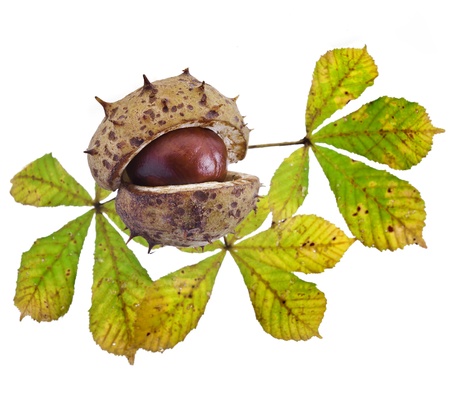
Horse chestnut

The genus Aesculus (/ˈaɪskjʊləs/) is a genus of flowering plants in the family Sapindaceae. They are trees and shrubs, mostly native to the temperate Northern Hemisphere, but one species (A. assamica) into subtropical areas of southeast Asia. The Plants of the World Online (POWO) database currently accepts 12 species, with seven species native to North America, four native to Asia, and one native to Europe;[1] some other authors have accepted more species. Hardin (1957-1960) accepted 13 species,[2][3][4] the Trees and Shrubs Online website cites "13–15" species with descriptions given for 14 species,[5] and Harris et al. (2009) accepted 16 species.[6] Six natural hybrids occur,[1] and several others have been raised in cultivation. The European and Asian species are known as horse-chestnut or horse chestnut, and the North American species as buckeye. Aesculus exhibits a classical Arcto-Tertiary distribution.[a]

Carl Linnaeus named the genus Aesculus after the Roman name for an edible acorn. The genus was considered to be in the ditypic family Hippocastanaceae along with Billia,[8] but phylogenetic analyses of morphological[9] and molecular data[10] have more recently caused this family, along with the Aceraceae (maples and Dipteronia), to be included in the soapberry family (Sapindaceae). The fruit of the Mexican buckeye resemble Aesculus fruit, but belong to a related though different genus Ungnadia.

The common name "horse chestnut" invites confusion with the chestnuts in the genus Castanea in the order Fagales; the name is often hyphenated as horse-chestnut to minimise this confusion.

Aesculus species are shrubs or trees growing to 4–35 m (13–115 ft) tall. They have stout shoots with resinous, often sticky, buds, with opposite, palmately divided, deciduous, leaves; these are often very large, to 65 cm (26 in) across in the Japanese horse-chestnut A. turbinata. The flowers are showy, insect- or bird-pollinated, with four or five petals fused into a lobed corolla tube, arranged in a panicle inflorescence. Flowering is in spring or summer, from February (rarely January) in A. assamica to July (rarely August) in A. indica and A. parviflora; some species may have a small second flowering in autumn. The fruit matures to a capsule 2–5 cm (1–2 in) diameter, usually globose, containing one to three seeds (often erroneously called a nut) per capsule. Capsules containing more than one seed result in flatness on one side of the seeds. The point of attachment of the seed in the capsule (hilum) shows as a large, circular, whitish scar. The capsule epidermis has "spines" (botanically, prickles) in some species, while in others the capsules are warty or smooth. At maturity, the capsule splits into three sections to release the seeds.[2][3][4]

The species of Aesculus accepted by POWO are:[1]

Aesculus seeds were traditionally eaten, after leaching, by the Jōmon people of Japan over about four millennia, until 300 AD.[11][12][13]

All parts of the trees are moderately toxic, but the attractive nut-like seeds are the most likely part to cause poisoning.[14][15] The toxin affects the gastrointestinal system, causing gastrointestinal disturbances. The USDA notes that the toxicity is due to the saponin aescin and the glucoside aesculin, with alkaloids possibly contributing.[16]

In North America, several native American tribes, particularly in the western and central United States, such as Miwok, Pomo, Yokut, Maidu, historically used buckeye seeds like California buckeye to harvest fish by using the saponins, which had been extracted by the plant's seeds. These tribes would crush buckeye seeds to release saponins into streams or shallow water, where the compounds would stun or kill the fish, allowing for easier capture. The resulting mash was thrown into still or sluggish waterbodies to stun or kill fish.[16][17] They then boiled and drained (leached) the fish at least three times to dilute the toxin's effects.[18] New shoots from the seeds also have been known to kill grazing cattle.[19]

In Britain, the fruit are often called conkers because of their link to the game of conkers, played with the seeds.

The most familiar member of the genus worldwide is the common horse-chestnut, Aesculus hippocastanum. The yellow buckeye, Aesculus flava (syn. A. octandra), is also a valuable ornamental tree with yellow flowers, but is less widely planted. Among the smaller species is the bottlebrush buckeye, Aesculus parviflora, a flowering shrub. Several other members of the genus are used as ornamental plants, and several horticultural hybrids have also been developed, most notably the red horse-chestnut Aesculus × carnea, a hybrid between A. hippocastanum and A. pavia.

The horse-chestnut A. hippocastanum was unknown to botanical science until 1596, when the Dutch botanist Carolus Clusius was given foliage and flowers in Vienna; it was then introduced further west, with the first plants reaching France in 1603, and Britain between 1612–1615.[20]

In Geneva, Switzerland, an official chestnut tree is used to indicate the beginning of the Spring; every year since 1818, the tree is observed by the secretary of the Grand Council of Geneva (the local parliament), and the opening of the first leaf is recorded and announced publicly. Over the years, four different horse chestnut trees have been used for these recordings.

In the 1840 U.S. presidential campaign, candidate William Henry Harrison called himself the "log cabin and hard cider candidate", portraying himself sitting in a log cabin made of buckeye logs and drinking hard cider, causing Ohio to become known as "the Buckeye State".[21]

The leaf of Aesculus was the official symbol of Kyiv on its coat of arms used from 1969 to 1995.[22] It remains an official symbol of Kyiv to this day.[22]